r-u-NbS? We're Still Asking!
Jul 23
13 min read

Seven years of Realising Urban Nature-based Solutions
What's in a name?
The Realising Urban Nature-based Solutions (r-u-NbS?) programme is entering its 7th year and we have a lot to share on where this work came from, what we built, how we talked about it, what we got wrong, and where we see the work going next.
To kick off, we wanted to go back to a small footnote from the origin story of the programme that points to an important debate on the power of words.
Back in 2019, when designing the programme we inserted a whimsical little question mark in the title… “r-u-NbS?”
Why? Well, as critical practitioners we had some important questions about what NbS was in practice, in our specific contexts… and we were at some level asking ourselves and our community partners… are we NbS? Do we fit the definition?
Seven years on, we have (some!) answers. This is part of the story of how we got there.
"Drainage with plants"
The question mark had roots long before the programme had a name. We have been working with nature as a solver since the very first days of KDI, and so it felt like a good question, though we were not using "NbS" back then.
In 2006, the New Nairobi Dam Community Group, the first site of the Kibera Public Space Project, had a fundamental challenge of flooding and poor drainage in their area. Together, KDI designed vegetated swales to help infiltrate and move water away from the ‘Productive Public Space’. Designers of the time might have called it Sustainable Urban Drainage, Best Management Practices, or Green Infrastructure. Our founding colleague Ibrahim Maina called it "drainage with plants".

Whatever words used, it was clear that combined with tree planting, urban agriculture, composting, and open green space, this improved drainage transformed the health, life, and vitality of the space. This corner of Kibera was dramatically changed, with nature and people at the base of the "solutions".
So the practice came first, and the label came later. But when the label did arrive, it turned out the words mattered more than we expected.
What is meant by "NbS" and why our words matter
Why does a design and community development organisation care about a debate over lexicons and terminology?
Words can define whose reality gets prioritised, in some cases, NbS has been a euphemism concealing displacement or gentrification, including in places and projects that we've seen and lived through.
Over time the words change, and sometimes that can obscure important truths.
Tamsin Farragher of IFLA Africa recently laid it out: "NbS, green infrastructure… sponge cities - and more. We just change the names, obfuscate the issues and create more confusion about who, what, and why"
It's ironic and problematic that NbS is often considered by officials and residents in Kenya as an imported "technology" by funders and western countries. Especially considering we are sitting in some of the most biodiverse areas of the world, and where communities have long been extraordinary custodians of natural systems. As researcher and architect Garett Gantner points out in their recent article about NbS in Rwanda and Kenya: "Nature-based Solutions' is just another way of framing bottom-up practices which have been employed in sub-Saharan Africa and many non-Western cultures for centuries" (Gantner, 2025). The arrival of NbS as something foreign does a disservice to that living knowledge.
If the argument over words is partly an argument over power, then the most grounded answer we know is to go back to what is physical, specific, and local.
NbS as place-based
Ultimately, NbS are things we can touch and feel in the world, and they may look and feel very different depending on where we are, what the soils are like, what plants work, and what kind of space is available. Many practitioners and researchers working with NbS have also come around to the need to produce evidence and experience that is situated, place-specific, and building from local knowledge.
This convergence is not accidental… the more NbS is tested across different contexts, the harder it becomes to separate what the solution is from where it's built. As Cook et al (2025) conclude in their recent overview of the field, there is a need for "studying place-based design, implementation, and functioning of NbS across diverse global contexts".
While debates remain over the use of the term and how it lands in practice, NbS has also been usefully described as a "travelling frame" (Mguni et al., 2016), where the qualities and definitions are "remade" depending on context. Our own community work and research on the r-u-NbS? experience in Nairobi (Kenya) and Dar es Salaam (Tanzania) uncovers the importance of making NbS together to understand its meaning and potential: "the need to embody a concept that is often associated with non-material and intangible values" (Diep et al., 2022).
That remaking only works when local communities are the ones doing it. When the frame travels to communities rather than being shaped by them, it risks becoming another version of the imported-technology problem.
Without a doubt, we have attempted many "remakings" as we've travelled through the r-u-NbS? programme from humble beginnings. That programme is where these ideas stopped being arguments and started being built. Here is how it began…

Origins of r-u-NbS?
Following the original "drainage with plants" experiment, KDI and our many CBO partners piloted a number of natural drainage techniques through the Kibera Public Space Project, alleviating hazardous conditions at a site scale. These include elements such as planted revetments, bamboo plantation, detention and infiltration structures (upcycling Coca-Cola crates as underground void structure, instead of expensive "stormblocs"), and rainwater harvesting. The approach is not fixated on green for green's sake, but the package of things that respond to people's challenges, needs, and vision for their place within constrained spatial and political spaces. As KDI co-founder Arthur Adeya and r-u-NbS? co-lead Franklin Kirimi recently wrote in the AJLA journal: "the co-design process is based on the belief that residents are the true experts of their environment" (Adeya and Kirimi, 2024).
In 2016 and 2017, we started to discuss the idea that "demonstrating that Green Infrastructure techniques can actually work in dense, urban and low-income areas at the small scale might be a starting point for inserting them into larger discussions" (KDI, 2017). This instinct was elevated by ideas from Patience Mguni and colleagues about how "niche experiments" with urban nature in African cities could be levers for sustainability transitions (Mguni et al., 2016). Put simply, we came to know that you need both technical and community evidence together if you're going to make a case for change at scale. That belief became the basis of the r-u-NbS? programme, which started in 2019.

Seven years of 'building it to believe it'
Our proposition with r-u-NbS? was a simple one: co-design, build, and evaluate small-scale drainage and NbS projects in real sites, with real communities, under real political conditions, in the major cities of East Africa… So what did seven years of testing that actually produce?
Since 2019, with our implementing partner the Centre for Community Initiatives (CCI) in Tanzania, the programme has delivered 66 NbS components across 5 informal settlements, in two countries and three cities: Nairobi, Embu, and Dar es Salaam. These are things built and tested in communities dealing with real flooding, real political and real social pressures. We tracked how they performed across 154 indicators through a Monitoring, Evaluation and Learning (MEL) framework the programme team built and refined as we went. Six gender and human-rights-based trainings shaped how we collected that data, so we could see who was benefiting from these spaces, and who was being left out.
Behind the indicators are people, and often children, finding new ways to use the places they live.
"My name is Haisan Said, I love my school more now because it has a good garden, trees and a good place to rest unlike before." — Student at Mapinduzi Primary School, Dar es Salaam (Source: CCI, 2020)

We also developed three community-led neighbourhood plans in Mji Mpya Vivunguti (Dar es Salaam), Kibera (Nairobi), and Dallas (Embu Town) using the Rivers & People approach, inspiring others in Kayole-Soweto and Mukuru (Nairobi). Rivers & People is our own methodology for riparian planning at the scale of settlements and river systems/watersheds, rather than one site at a time. Working from the recognition that a well-designed swale means little if the watercourse it connects to is blocked or contested upstream, Rivers & People links NbS pilots to the broader ecological and political landscapes they sit within. The process draws on participatory mapping, focus group discussions, spatial analysis, and validation workshops to build plans grounded in community knowledge of how their watercourses and neighbourhoods actually function, who governs them, and what a viable future for that river corridor might look like. Rivers & People is a contextual response to the conditions in African cities highlighted by Gantner (2025): “as opposed to a ‘project-based’ approach more common in the Global North, the cities of sub-Saharan Africa are likelier to benefit from a ‘network-based’ approach to NbS implementation.”

None of this stayed in Kenya and Tanzania. From 19 conferences, fora, lectures and other dissemination platforms, we engaged communities, researchers and stakeholders, including lead-authors of the IPCC Special Report on Climate Change and Cities in 2025. We’ve worked with multiple researchers and students in Kenya, Tanzania, and further afield. We have produced a number of blog articles (on our website) and two journal articles (Diep et al, 2022, and Nilsson et al, 2024).
Alongside these real "concrete, non-concrete" facts on the ground, an evolution of process and language has unfolded, in response to community priorities, needs, and to changing political and physical climates. Because hard data on its own is not enough. It has to travel, and it has to translate.
Travelling Frames
Translation, in the broadest sense, became a core part of our work within r-u-NbS?, at site, planning, and policy scales. We looked for relatable stories and local examples to explain what it means to learn from the way nature works. Mostly this meant drawing a comparison people already knew: the upcountry landscapes, and the national parks and forests around Nairobi, set against the city's own neighbourhoods and industrial areas. In those wilder systems, water, soil, and plants move in closed loops, where what one part discards another one uses. In the city, those loops are broken, and the flooding and pollution people live with are part of what that breakage looks like. The point we kept coming back to was a simple one… cities have a lot to learn from how nature already does it.
That comparison did a lot of work for us, but some of the most resonant translations of NbS came from the community itself. In one workshop in Mukuru settlements, participants brought up the Swahili phrase "Njia za Kimungumungu", meaning roughly "methods (or ways) of the divine." It was their own way of describing NbS: nature understood as something sacred, God's way of working in the world. To us this is not merely poetic, rather it reflects a worldview in which the relationship between people and nature carries spiritual and moral weight, not just technical utility.
Beyond the limits of words, we turned to visuals. We developed easy-to-read illustrations and before-and-after images that depicted NbS functions and benefits within local or site settings. The specificity mattered; people need to see themselves and their environments reflected in the renderings of futures they choose.


Translating the work honestly also means being open about the parts that did not go to plan. This is where our partner, SwedBio, has always encouraged us to manage challenges adaptively, and be open and transparent about failure and learning.
Failing, Learning, and Sharing
In seven years, a lot can happen, and the process has undergone many challenges that we have had no choice but to face up to and learn from.
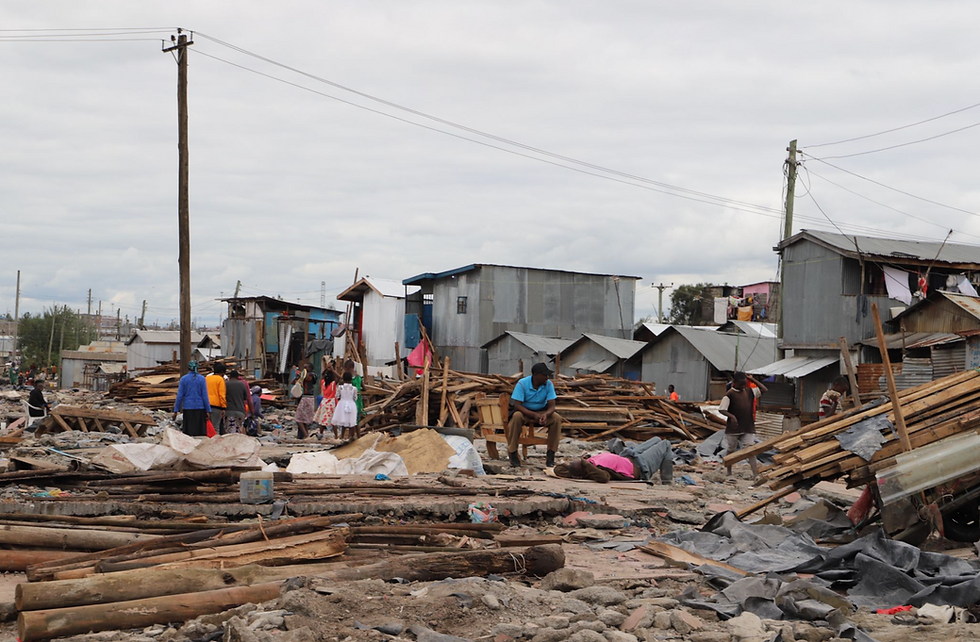
In 2024, amidst heavy rainfall and devastating floods, Nairobi saw renewed action to reclaim and restore its rivers. That action came as large-scale forced evictions and demolitions of informal settlements, displacing over 100,000 people (Flowing Together Coalition, 2024). Communities that had come together to plan were scattered, and our attention turned to supporting residents in voicing and acting against this injustice. The planning work was set back, and the adaptation strategies and vision plan we’d built together were overtaken by events.
This is not new. Community-led adaptation is repeatedly disrupted by such actions, an ever-present risk where land tenure is not guaranteed. It raises the importance of adaptive planning processes that can be recalibrated as conditions change.
And yet, while the vision plan was superseded, something else held. The trust, the partnerships, and the organising capacity within the community were stronger afterwards than before. Non-profits, civil society, and community-based groups redirected resources to those affected through charitable donations and a joint eviction petition we contributed to.
The rain itself taught us something harder. Extreme rainfall events exceeded what we had designed for, and some NbS features overflowed. At the Bridge International Academy in Mukuru kwa Reuben, the flooding that hit Nairobi's informal settlements simply overwhelmed the project. The failures of the surrounding public infrastructure compounded the health risks, and remained unresolved. These were hard lessons about how much weight a well-built site can carry when the wider settlement's infrastructure around it is broken, and about the limits of the smaller-scale interventions acting alone.
This body of experience has made a contribution in terms of the debate on urban NbS. The question is no longer whether NbS can function in informal urban settlements, but the degree of opportunity NbS holds. Our evidence from Kibera and Mukuru in Nairobi, Dallas in Embu, and Vivunguti and Mji Mpya in Dar es Salaam has revealed much of this opportunity. Some of these learnings have been documented in a recent in-depth study of the r-u-NbS? programme by the African Cities Research Centre (Hernandez-Montilla, 2026).
It has been argued that some interventions at the very local scale may not qualify as NbS as they may not clearly demonstrate “biodiversity benefits” (as per the IUCN NbS definitions). r-u-NbS? attests that they can be. People and nature initiatives can be NbS, and when they are linked together through larger-scale planning like Rivers & People, they can create ecological connectivity that makes a difference on multiple fronts, including biodiversity.
The question remains whether the institutions, governance systems, and planning frameworks around these communities are prepared to adopt and scale what communities and practitioners have shown can work.
What next for r-u-NbS?
After 7 years of working explicitly with NbS terminology, and with 20 years’ experience of "drainage with plants"... we believe we have shown that working with natural systems in social and physical infrastructure design can build local and systemic resilience.
Ultimately, NbS is an important vehicle to unlock resources and influence policy. It's a space for people interested in urban nature, biodiversity, and social justice, and a means for surfacing inherent tensions to hit multiple goals. Within that space, we're holding fast to the principles of community-led design to ensure it really works for and with people.
From small beginnings, the work and approaches have reached multiple communities, as well as County and National governments. In the Nairobi Urban Fabric Initiative, the work has shaped KISIP's approach to climate-adaptive community infrastructure, co-managed by County and Community through 'Service Level Agreements', and is now being replicated countrywide. In the ASILI Embu Programme co-funded under r-u-NbS?, Kenya's first Green Infrastructure Plan was adopted by the county, seeding further "Rivers & People" approaches. KDI has advised the government's Nairobi Rivers Commission, advocating for community-centred approaches to riparian regeneration at a moment when those corridors are under intense pressure. The forced evictions are ongoing and deeply contentious.
This year we will be releasing the full MEL datasets for all r-u-NbS? sites to support practitioners, civil society, and local government in developing the technical and governance systems required to deliver viable NbS. Alongside that, we will be developing a playbook for equitable green infrastructure across different urban typologies.
We're also excited that much of the learning from r-u-NbS? has been taken forward into different programmes, including a significant multi-year research and action project - ‘Listen, Learn, Leap’ (3L) - together with dear colleagues at University College London, Ardhi University, and CCI in Tanzania (CCI were original r-u-NbS? partners).
3L takes what we developed through KPSP and r-u-NbS? and continues to evolve: the co-design of urban people-nature sites, the MEL framework, and the Rivers & People planning approach. The team brings a renewed emphasis on gender, youth, and design for the "more-than-human", plus exciting profiling and celebration of Nature and People initiatives across Nairobi and Dar. Follow the 3L work here.




Comments